How it compares
Windrose Power vs. PU2000
Both are 2 MWh containerized battery systems. The key difference: Windrose Power is a mobile EV charging hub with built-in CCS and MCS guns. The PU2000 is a stationary grid-services BESS with higher AC discharge power but no onboard chargers.
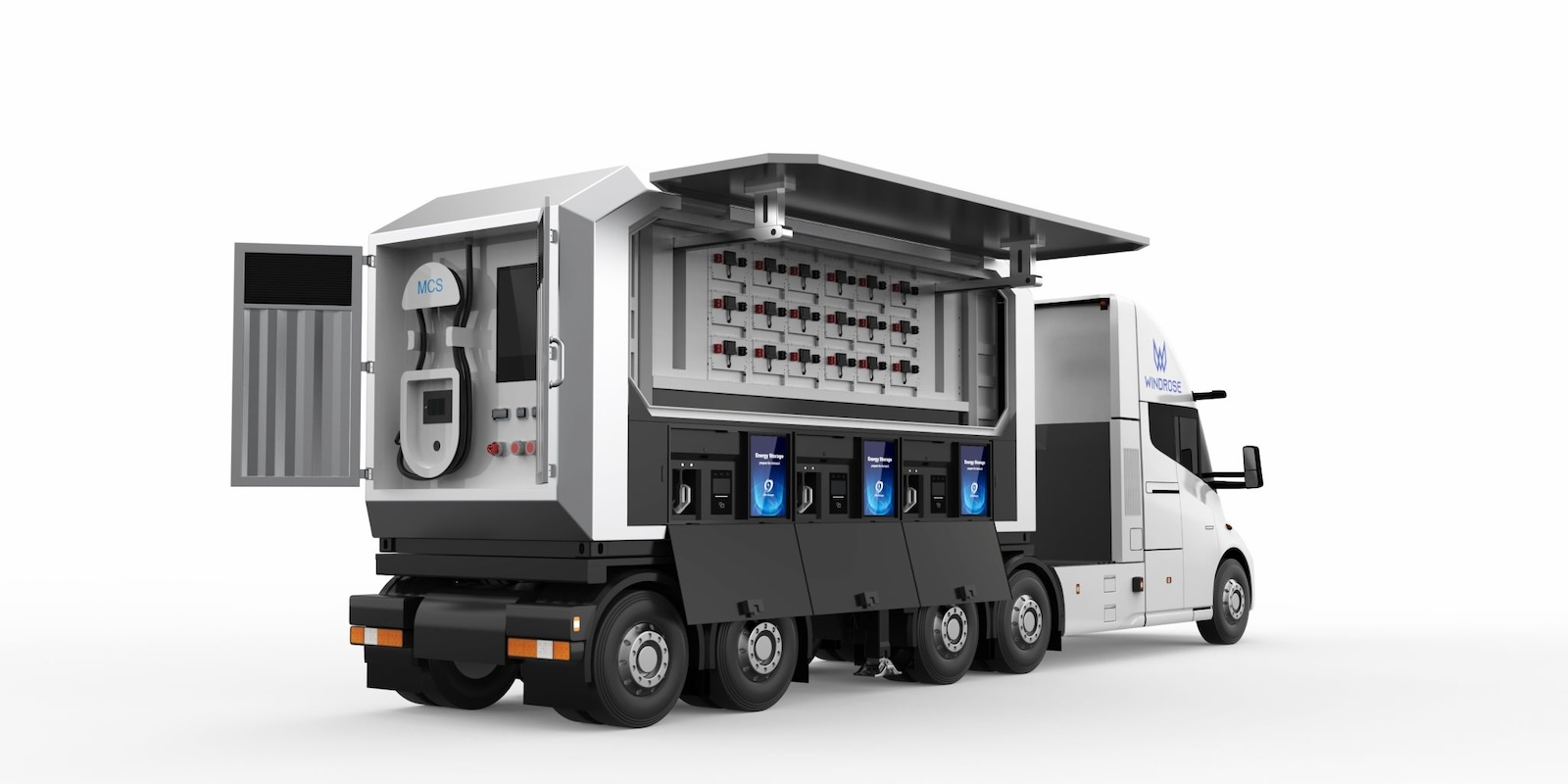
Windrose Electric
Windrose Power
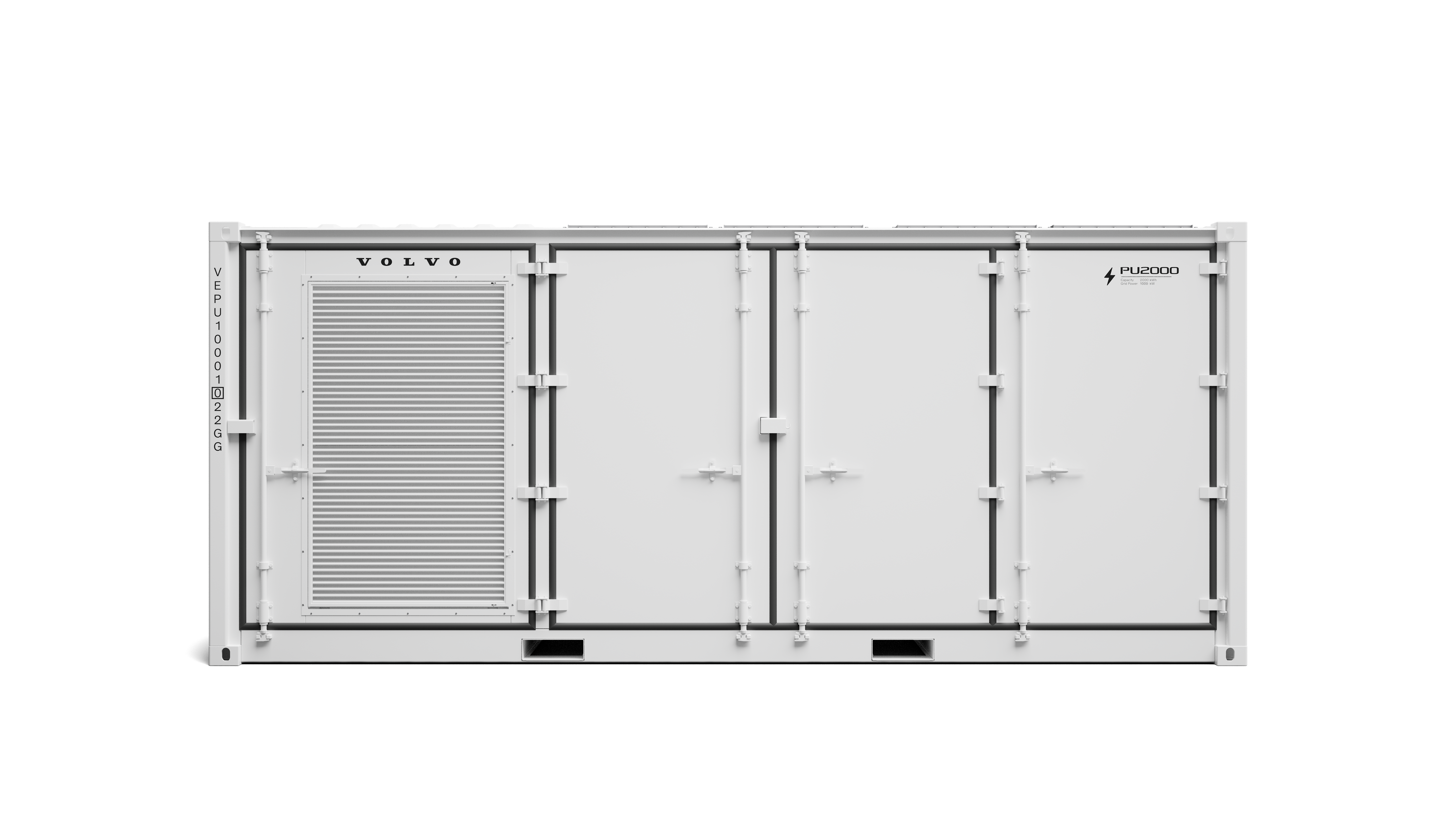
PU2000
Windrose Power · Battery Chemistry
LFP
Lithium Iron Phosphate
The iron–phosphate bond (Fe–PO₄) is one of the strongest in lithium-ion chemistry. Even at extreme temperatures, this bond holds its structure and does not release oxygen. Without free oxygen, the chain reaction that triggers thermal runaway — oxygen + heat + flammable electrolyte — cannot start. LFP is stable to ~270 °C before decomposing, vs. ~150 °C for NCA.
PU2000 · Battery Chemistry
NCA
Nickel Cobalt Aluminum
Nickel–cobalt oxide bonds release oxygen above ~150 °C. That oxygen reacts with the flammable electrolyte, generating heat that accelerates further decomposition — the exothermic cascade known as thermal runaway. Active cooling systems manage this risk under normal operation but cannot prevent it under severe abuse or failure.
Battery Lifetime: LFP vs NCA
At one full charge/discharge cycle per day, LFP reaches 8,000+ cycles in over 20 years with minimal capacity fade. NCA chemistry degrades faster under heavy daily cycling, typically reaching end-of-life around 8 years. LFP also carries no thermal runaway risk — a critical safety advantage for mobile, outdoor deployment.
| Windrose Power | PU2000 | |
|---|---|---|
| Battery | ||
| Capacity | 2 MWh | 2 MWh |
| Cell chemistry | LFP Advantage | NCA (Li-ion) |
| Thermal management | Liquid cooling | Liquid cooling |
| Operating temperature | −40 to +55 °C Wider | Not published |
| Power & Charging | ||
| Output power | Up to 2 MW IntegratedMCS megawatt-level DC charging, CCS fast charging, or 500 kW AC — all from one unit, no separate charger | 1 MW ACNo onboard EV charging — requires a separate charger |
| Grid input | 500 kW AC | Not specified |
| Solar input | Up to 500 kW Built-in | Not specified |
| Physical & Installation | ||
| Deployment type | Mobile / trailer-mounted Flexible | Stationary container |
| Weight | 25 T | 19.5 T Lighter |
| Protection rating | IP54 overall / IP65 battery Specified | Not published |
| Corrosion protection | C4 std., C5 optional | Not specified |
| Connectivity & Safety | ||
| Grid / BMS protocols | Modbus-TCP · IEC 61850 · IEC 104Modbus-TCP: industry-standard protocol for BMS, inverter control, and SCADA integration over Ethernet. IEC 61850: substation automation standard — enables direct coordination with grid protection relays and switchgear. IEC 104: utility telecontrol protocol used by grid operators (TSOs, DSOs) for remote monitoring and dispatch over TCP/IP. | Modbus TCP/IP · REST API · 4G |
| On-site display | 10-inch & 32-inch HMI | Not specified |
| Fire suppression | Not specified | PFAS-free direct injection Built-in |
| Customization | OEM / ODM available Flexible | Standard product |
Choose Windrose Power when…
You need an integrated EV charging hub
- Fast charging without a separate charger build-out
- MCS megawatt charging for trucks or buses is required
- Mobile or temporary site deployment
- Solar PV integration on a single unit
- Maximum battery longevity — LFP at 8,000+ cycles
- Custom configuration (OEM / ODM)
Choose PU2000 when…
You need stationary grid-scale storage
- Peak shaving, load shifting, or grid market revenue
- High AC discharge power (1 MW) from a single unit
- Scaling beyond 2 MWh — up to 10 units for 20 MWh
- Built-in fire suppression required by code
- Volvo service and warranty network preferred
- Weight is a constraint (19.5 T vs. 25 T)
Sources: Windrose Power datasheet · Volvo Energy PU2000 product page · Volvo Group press release (Oct 2025). Volvo PU2000 data reflects publicly announced specifications; some parameters are not published by Volvo.