A Windrose Field Note

Every battery chemistry is a trade, not an invention.

From a 1991 Sony camcorder cell to a battery pack with no liquid inside it at all — the thirty-five-year argument between energy density, safety, cost, and cycle life, told through the cars and countries that decided each round.

9 chemistries 5 countries led at least one 1991–2028 span
1991

Lithium Cobalt Oxide LiCoO₂

🇯🇵 Sony — the chemistry that made "lithium-ion" a household possibility
Tesla Roadster (2008)Wikimedia

Every chemistry on this page is a descendant of one 1991 decision: Sony needed a rechargeable cell for camcorders, and cobalt oxide's neat layered structure gave lithium ions a clean staircase to climb. It was never meant for a car — cobalt is expensive, and a fully-charged LCO cell is genuinely dangerous if punctured or overcharged.

Which is exactly why the first electric car of the modern era used it anyway. Tesla's 2008 Roadster was built before any EV-specific chemistry existed at automotive scale, so it used thousands of repurposed 18650 laptop cells — cobalt oxide, wired in the only configuration anyone knew how to mass-produce.

IonLithium (Li⁺)
CathodeCobalt oxide only
AnodeGraphite
2008–2012

Nickel Cobalt Aluminum LiNiCoAlO₂

🇯🇵 Japan (Panasonic) — the chemistry that proved an EV could out-range gasoline
Tesla Model SWikimedia

Refine cobalt oxide's family tree far enough and you get NCA — swap most of the cobalt for nickel, add a trace of aluminum for stability, and the energy density climbs high enough to make a genuinely long-range car plausible. Panasonic had been perfecting it for consumer cells for a decade; Tesla needed exactly that density for the Model S.

It remains, a decade later, the highest energy-density chemistry on this page — and the most demanding to keep safe.

IonLithium (Li⁺)
Cathode~80–85% nickel + cobalt + aluminum
AnodeGraphite
SourcingNi/Co: Indonesia, Philippines, DR Congo — heavily China-refined
2015 →

Nickel Manganese Cobalt LiNiMnCoO₂

🇰🇷 Korea (LG Chem, Samsung SDI) + 🇨🇳 China (CATL) — the compromise everyone else built on
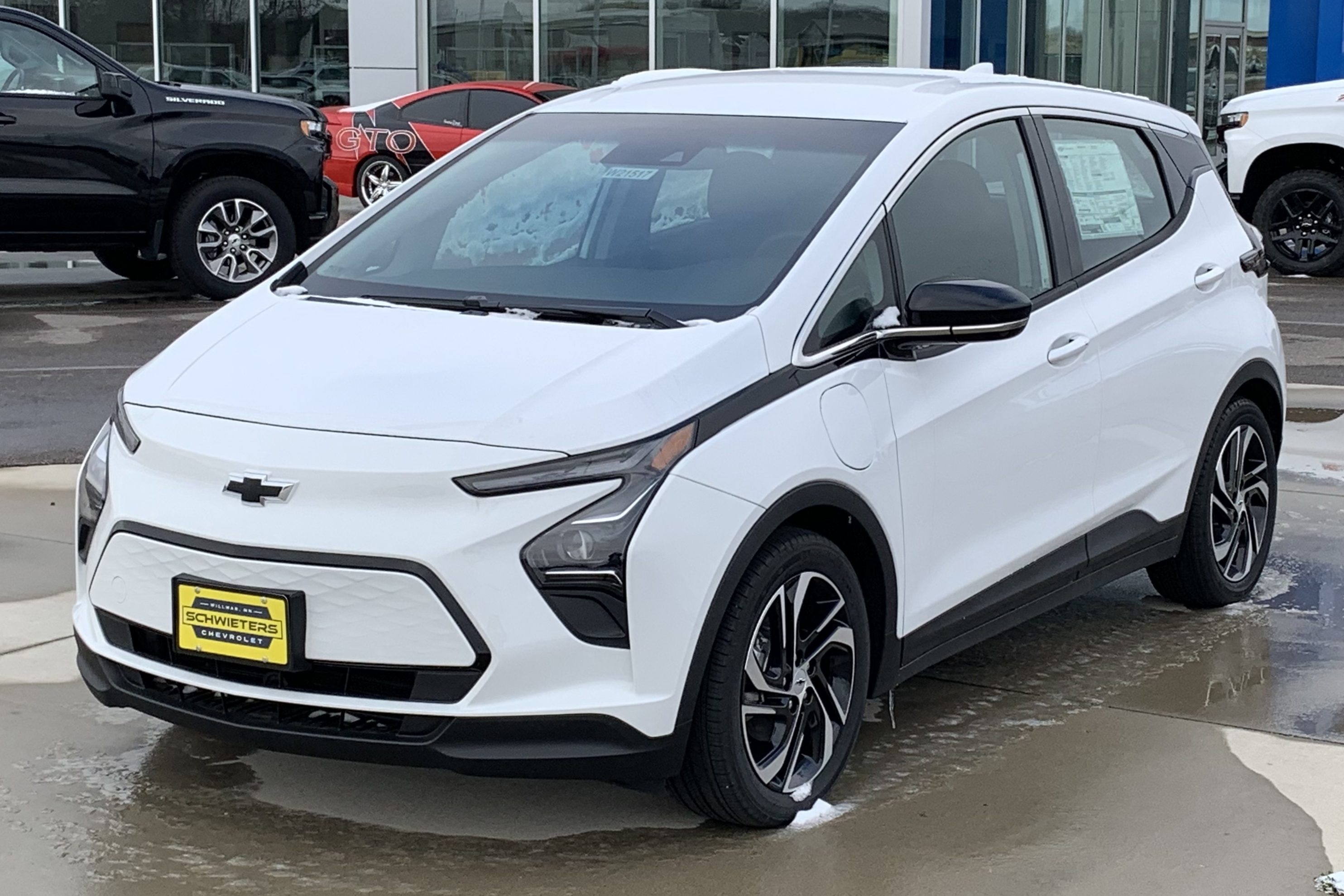
Chevrolet Bolt EVWikimedia

NCA answered "how far can it go." NMC answered "how do we make that at scale, from more than one country." Splitting the nickel three ways with manganese and cobalt costs some energy density but buys tunability — a "622" or "811" cell (the numbers are the Ni:Mn:Co ratio) can be dialed toward range or toward cost. Korean and Chinese cell makers built entire industries on the flexibility.

It became, without much fanfare, the default chemistry for almost every EV that wasn't a Tesla or a Chinese-market car — the Bolt, the Mach-E, the Ioniq 5, the ID.4.

IonLithium (Li⁺)
CathodeNi + Mn + Co, ratio varies (e.g. "811" ≈ 80/10/10)
AnodeGraphite
1996 → 2020

Lithium Iron Phosphate LiFePO₄

🇺🇸 Invented at UT Austin → 🇨🇳 China (BYD, CATL) — the 24-year gap between patent and dominance
BYD SealWikimedia

LFP is the strangest story on this page, because its inventors never got to lead it. John Goodenough and Akshaya Padhi patented it in 1996; American startup A123 Systems commercialized it early for power tools and grid storage. But phosphate's real advantage — a rock-stable crystal structure that essentially can't decompose into an oxygen-releasing fire, plus zero dependence on nickel or cobalt — is a manufacturing-cost story as much as a chemistry one, and it took China's BYD, with its 2020 "Blade Battery," to prove LFP could be packed dense enough and cheap enough to become the mass-market EV chemistry.

Once BYD and CATL scaled it, LFP went from "the safe but heavy option" to the chemistry under most Chinese-market EVs and Tesla's own Shanghai-built cars.

IonLithium (Li⁺)
CathodeIron phosphate only — no nickel, cobalt, or manganese
AnodeGraphite
SourcingLi: Australia/Chile mining, China-refined. P: Morocco holds ~70% of reserves.
2023–2025

Lithium Manganese Iron Phosphate LiMnFePO₄

🇨🇳 China (Gotion, CATL, EVE) — LFP's answer to "what if we need 15% more range"
Zeekr 007Wikimedia

LMFP is the newest entry in the phosphate family, and Windrose's own WH21 truck cell is exactly this chemistry: substitute manganese directly into LFP's crystal lattice, and cell voltage climbs from ~3.2V to ~3.57V — most of the energy-density gain, for free, without touching the phosphate backbone's safety or cost profile.

One thing to watch: "pure" LMFP (manganese substituted into the lattice, still zero nickel/cobalt) is not the same product as a "blended" LMFP, where a maker physically mixes in a small fraction of NMC-type material — CATL calls its version "M3P." The blend does contain trace nickel and cobalt; the pure version doesn't. Ask which one a supplier means.

Zeekr's 007 and Xiaomi's SU7 both run LMFP-family CATL cells — the first wave of passenger EVs built specifically to exploit this middle ground.

IonLithium (Li⁺)
CathodeIron phosphate + manganese — still no Ni/Co (pure form)
AnodeGraphite
1980s → 2023

Sodium-Ion NaxMO₂

🇨🇳 China (CATL, HiNa) — the chemistry that lost the first round on purpose
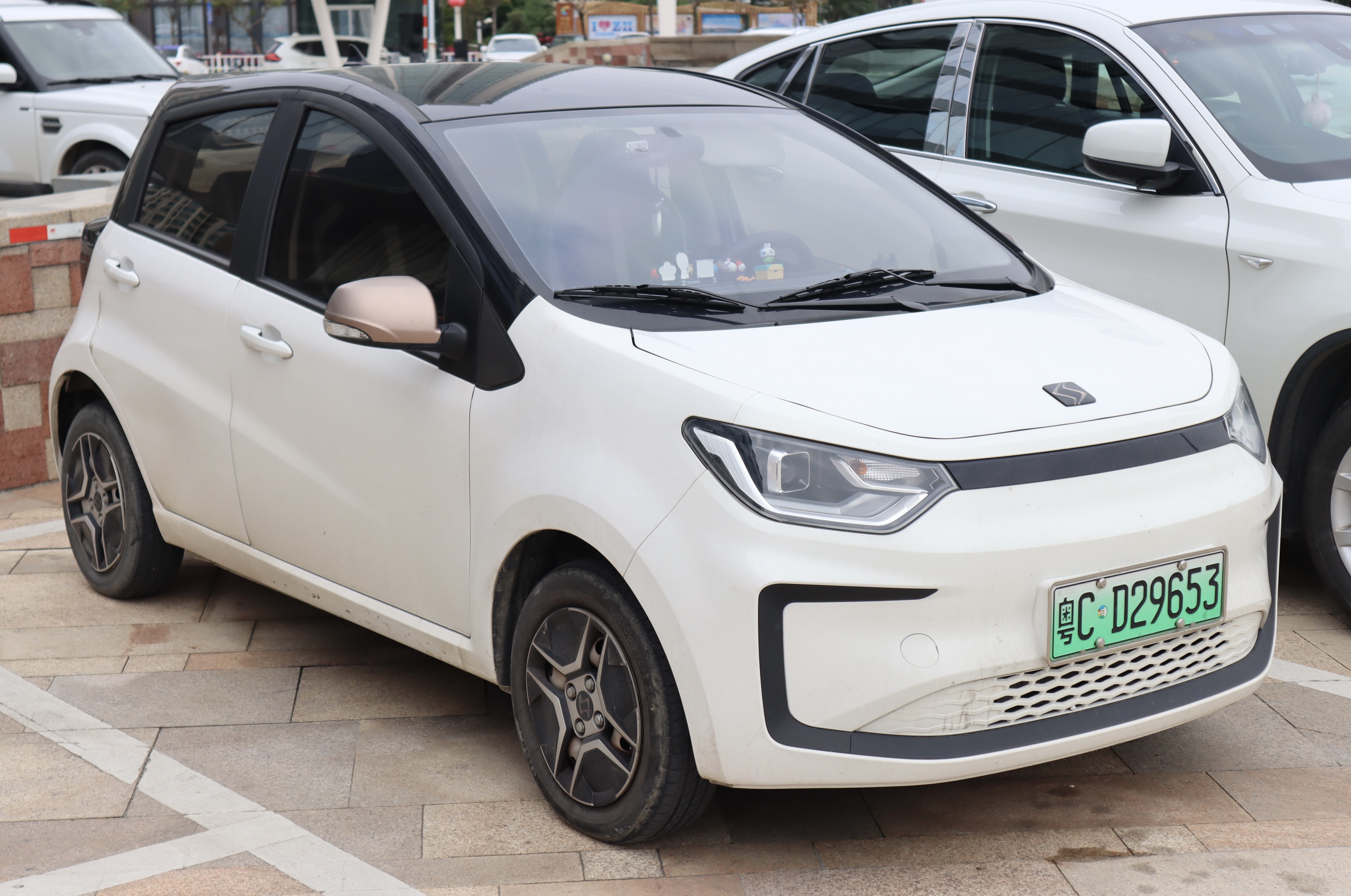
JAC Sehol E10XWikimedia

Sodium-ion isn't a new idea — researchers studied it alongside lithium in the 1970s and 80s, before lithium's higher energy density made the choice obvious and sodium research was quietly shelved for forty years. It came back only when lithium and cobalt supply security became a strategic worry rather than a chemistry problem: sodium comes from ordinary salt, is present essentially everywhere on Earth, and can't run out in any meaningful sense.

CATL announced its first generation in 2021. Two years later, JAC's Sehol E10X became the first production car with a sodium-ion pack — not because it was better, but because for a small, cheap city car, "good enough and unconstrained by mining geography" beat "denser but geopolitically exposed."

IonSodium (Na⁺) — not lithium at all
CathodeLayered oxide, Prussian-white/blue, or polyanionic — no Li, Ni, or Co
AnodeHard carbon (not graphite)
2011 → 2017

Silicon Anode Si / Si-C composite

🇺🇸 US (Sila, Group14, Amprius) → adopted in Panasonic/Tesla cells — the upgrade that isn't a cathode at all
Tesla CybertruckWikimedia

Every chemistry above this line changed the cathode. Silicon anodes change the other electrode instead — and any of them can use it. Silicon can theoretically hold ten times as much lithium as graphite, by weight, which is why a wave of American startups (Sila, Group14, Amprius, all founded between 2008 and 2015) bet entire companies on it.

The catch is physical, not chemical: silicon swells roughly 300% as it absorbs lithium, which cracks a pure-silicon anode apart within a handful of cycles. Every production cell today blends a modest 5–20% silicon into graphite instead — Panasonic's 2170 and 4680 cells, built for Tesla, among the first at real scale.

IonLithium (Li⁺) — an anode swap, not a new ion chemistry
CathodeUnchanged (commonly NCA/NMC today)
AnodeSilicon-carbon composite blended into graphite
January 2023

Semi-Solid-State gel electrolyte

🇨🇳 China (WeLion → NIO) — the "someday" technology that shipped early
NIO ET7Wikimedia

Solid electrolytes had been "five years away" for most of the 2010s. China's WeLion New Energy skipped the wait by shipping a hybrid: part liquid, part solid — a gel that captures some of solid-state's safety and density benefits without solving every manufacturing problem a fully solid cell demands.

It went into a real production car faster than almost anyone predicted. NIO's ET7, fitted with WeLion's 150 kWh semi-solid pack, drove 1,044 km on a single charge in January 2023 — a genuine production-vehicle result, not a lab demo.

IonLithium (Li⁺)
CathodeTypically high-nickel NMC — the electrolyte changed, not the cathode
AnodeGraphite or lithium-metal-adjacent
~2027–2028

Full-Solid-State sulfide / oxide / polymer

🇯🇵 Japan (Toyota) — thirty years of patents, still waiting for a production car
No production vehicle yet

This is the chemistry every other entry on this page has been quietly racing toward: remove the liquid electrolyte entirely, and a lithium-metal anode — too dendrite-prone to trust with any liquid inside a cell — finally becomes safe to use. That single change could unlock energy densities none of the chemistries above can reach.

Toyota has spent over two decades building the industry's largest solid-state patent portfolio, mostly around sulfide electrolytes, and still targets 2027–2028 for a first production vehicle. QuantumScape (backed by Volkswagen) and Solid Power (backed by BMW and Ford) are the leading Western challengers; CATL and Chinese state-backed programs sharply accelerated their own investment from 2023, unwilling to watch this one slip away too.

IonLithium (Li⁺) in nearly all programs
CathodeVaries — high-nickel NMC-type most common in prototypes
AnodeLithium-metal — only viable with a solid electrolyte

Where Windrose sits on this tree

Every chemistry above is a real, working answer to the same four-way argument: how much energy per kilogram, how many years before it degrades, how much it costs to make, and how badly it behaves if something goes wrong. None of them win on all four axes — that's not a limitation of engineering, it's the actual physics of the periodic table.

Windrose's WH21 cell — LMFP — is a deliberate bet on the middle of that argument: it gives up some of NMC and NCA's energy density in exchange for staying in the phosphate family's safety and cost class, while still capturing a meaningful voltage gain over plain LFP. For a heavy truck, where a thermal event is a much bigger problem than in a passenger car and where cost scales with a much bigger pack, that's the trade that makes sense today — even as sodium-ion, silicon anodes, and solid electrolytes keep shifting where "today" sits.